Come Jan 2020 Are We Going to Be Allowed to Upload Theme Park Videos
| Theme Park Globe | |
|---|---|
 | |
| Developer(s) | Bullfrog Productions Climax Development (PS/PS2) Zonic (macOS) |
| Publisher(due south) | Electronic Arts Feral Interactive (macOS) |
| Producer(due south) | Jeff Gamon |
| Composer(due south) | James Hannigan |
| Platform(s) | Microsoft Windows, PlayStation, PlayStation 2, Mac OS |
| Release | Microsoft Windows
|
| Genre(s) | Construction and direction simulation |
| Mode(s) | Unmarried-role player |
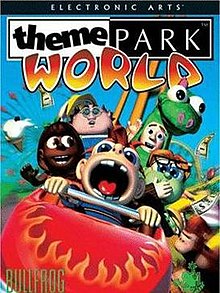
Theme Park World , besides known as Theme Park 2 , and in Northward America every bit Sim Theme Park , is a 1999 construction and management simulation game developed past Bullfrog Productions and released by Electronic Arts. The straight sequel to Theme Park (Theme Infirmary and Theme Aquarium are thematic sequels), the player constructs and manages an amusement park with the aim of making profit and keeping visitors happy. Initially adult for Windows, information technology was ported to PlayStation and PlayStation 2 (whose version was titled Theme Park Roller Coaster in Due north America), too for Macintosh computers. The Mac version was published past Feral Interactive.
The game was developed considering personnel at Bullfrog wanted to bring the original Theme Park up-to-date. Theme Park Earth features four themes of entertainment park, the ability to ride attractions, and an online service that enabled players to share parks. Reception was generally positive, with reviewers complimenting the sound and visuals, although some were critical of the interface. The game was followed by Theme Park Inc (also known equally Sim Coaster) in 2001.
Gameplay [edit]

A typical Lost Kingdom park. At the lesser right is the adviser.
Theme Park World tasks players with managing a series of entertainment parks.[1] To do this, the player must choose how to spend their funds, finding ways to expand the number and scope of their parks while remaining profitable.[2] [3] Money can be used to purchase things such as new rides or attractions,[4] and rent staff to maintain the park.[v] Equally in its predecessor Theme Park, the staff available for recruitment include mechanics, cleaners (known in some versions every bit handymen[6]), entertainers, and guards,[7] but Theme Park World besides introduces a new office: scientists (known in some versions as researchers[8] [9]).[10] The staff repair rides, clean litter, entertain visitors, ensure the park's security and research new rides, shops, and attractions.[11] Staff can be trained to make them more than efficient,[12] and require frequent rest in staff rooms.[13]
Rides can be upgraded to increase their reliability, chapters, and speed,[14] too as provide additional components for track-based rides, such as jumps and tunnels for race tracks,[15] and loops for roller coasters.[16] Toilets and features such as bins, speakers, and security cameras tin besides be purchased.[17] Various elements tin can be controlled past the role player, such as the name of the park,[18] the toll of admission,[19] the layout of the roller-coaster tracks,[20] and the quality of goods in the shops.[21] The actor tin build cafés, novelty stores, restaurants, and parlours for foodstuff such every bit fries (fries), ice creams, and burgers.[22] In the PlayStation version, certain rides and sideshows are playable equally minigames such as races and ix puzzles.[23] The role player can take loans and purchase additional land for the park.[24]
A fundamental focus is maintaining company satisfaction: the player is provided with feedback on visitors' merriment in the forms of a happiness meter,[25] and thought bubbles.[26] The bubbles convey feelings such every bit confusion, pleasure, hunger, and hygiene, which are indicators of the park's success.[27] There is an adviser who provides tutorials and data near the park's events.[28]
The player can earn gold tickets or keys for completing tasks such as getting a certain number of people in the park, reaching a certain happiness level, and making a certain profit in a year.[29] Golden tickets can be used to buy special rides that cannot otherwise exist researched by park scientists, also every bit unlock gilt keys needed to open additional parks.[thirty] The requirements for earning golden tickets are similar in each park, but get harder equally the game progresses.[29] At that place are four themes of park: Lost Kingdom (featuring mainly mesozoic, but likewise Aztec, Mayan, and Ape-based rides[31]) Wonder State (described as a "fairy kingdom"[32]), Halloween World, and Space Zone,[33] with Space Zone being the hardest.[13] In the PlayStation version, there are two parks for each theme.[34] Each world has setting-appropriate rides, shops, and sideshows.[35] Only the Lost Kingdom and Halloween World are available at the start (in the PlayStation version, the players outset in the Lost Kingdom[36]).[37]
The player can ride rides,[38] and bout the park in the commencement-person view.[39] In the PlayStation version, four golden tickets are required to use the latter feature.[39]
There is also an Instant Activity way, in which the thespian starts with a pre-built park in the Lost Kingdom, some staff, and double the usual corporeality of money. It features automatic research and cheaper staff, tracks, and expansion, only certain rides, shops, sideshows, upgrades, and features are not bachelor.[25] [40] [41]
Theme Park World Online [edit]
The Theme Park World Online website contained news and updates to the game, and featured a page that contained published parks. Invitations to parks could exist issued, and players could vote for their favourites.[42] Competitions were hosted, with prizes awarded for the all-time parks.[43] Players could besides visit others' published parks.[44] Platinum Tickets, which were used to download rides from the website, were awarded when others visited the role player's parks.[43] Postcards could be sent past electronic mail,[45] and the service offered a conversation characteristic.[46] The chat service had a function to report abusive players, who would have their connexion terminated.[47] Players could as well be blackmarked.[48] An account was required to use Theme Park World Online.[43]
Development [edit]
Theme Park World was announced (as Theme Park two) in April 1999.[49] [l] Many Bullfrog personnel had wanted to produce an updated version of Theme Park.[49] Producer Jeff Gamon said that and that players wanted to ride rides they created and Bullfrog built on the original game's success using the latest applied science. Gamon too said that Theme Park Globe would be less objective-based and more than open-ended than the previous Theme games.[51] Early in evolution, in that location were 12 artists, who were led past Darran Thomas before he left Bullfrog with Jeremy Longley and Glenn Corpes to found Lost Toys.[52]
The game used a 3D engine to eliminate the need for a 3D accelerator card, and an advanced behavioural artificial intelligence organization (programmed by Ben Board[53]) that gave visitors different behavioural traits.[49] Lath said that the nigh of import feature was the queuing behaviour, and that he spent a while making it look interesting when visitors were in long queues.[53] Many management features of the original game were retained,[54] but some, such every bit supply ordering and competition with other parks, were removed.[55] Staff would no longer get strike action considering it was considered confusing and abrasive.[56]
Theme Park World originally used the Populous: The Beginning engine, merely it was "limiting", and a new one was congenital.[57] Most of the development squad were from Mindscape: they were brought to Bullfrog to consummate Night Omen. After Theme Resort was cancelled, its team joined the people from Mindscape to develop Theme Park two.[53] As of October 1999, evolution of the PlayStation version was two months behind the PC version, and there was a greater emphasis placed on the minigames to compensate for its lack of net connectivity.[57] The internet connectivity and the ability to ride rides were developed in response to criticism of the original game's repetitiveness.[49]
In August 1999, Theme Park World was renamed every bit Sim Theme Park for North America, and was released as part of Maxis' (a sis company of Bullfrog) Sim line.[58] The renaming was to make the game easy to recognise past all types of gamer.[58] Bullfrog General Manager Bruce McMillan said that the Theme series was much stronger in Europe and Asia than North America, and the re-branding would inform gamers of the type of gaming experience the game would offer. He also said they were pleased to piece of work with Maxis, which would let the game to become popular in the United States.[58] Luc Barthelet, Maxis' General Managing director, said Theme Park World "is a great game" and that he was pleased to take information technology as part of the Sim series, but expressed jealousy at Bullfrog for developing such a game before Maxis.[58]
Theme Park Globe was released for Microsoft Windows on 3 November 1999; it was released for Europe on 19 July 2000.[59] The Japanese version was published by Electronic Arts Square.[two] It was released on Macintosh by Feral Interactive on viii December 2000.[60] The PlayStation version (adult past Climax Studios[61]) was released on 22 March 2000 (16 March in Japan[62]),[63] and the PlayStation two (titled Theme Park Roller Coaster in North America) version was released on 5 December 2000 (iv March 2000 in Japan[64]).[65] The European PS1 and PS2 versions were released in July 2000 and Dec 2002, respectively. Theme Park World was released on the PlayStation Portable and PlayStation three via the PlayStation Store in N America on eleven February 2010,[66] and in Japan on 24 Dec 2009.[64]
The adviser is voiced by Lewis MacLeod in UK release.[67]
Reception [edit]
Theme Park World received generally positive reviews, though it failed to match the success of its predecessor.[88] In North America, it sold 309,516 units and earned $8.51 one thousand thousand from January through October 2000, co-ordinate to PC Data.[89] These figures rose to 563,299 units and $13.08 million past the cease of 2000, which fabricated Sim Theme Park the region's eighth-best-selling reckoner game for the year.[90] In 2001, the game took 9th in the U.s. for the year,[91] with sales of 514,288 units ($nine.92 million).[92] The game was later given a "Platinum" sales laurels past the Amusement and Leisure Software Publishers Clan (ELSPA),[93] indicating sales of at least 300,000 copies in the United Kingdom.[94]
The PC version was praised highly by Robert Coffey of Reckoner Gaming Globe: he believed the game is "Wildly entertaining" and liked the ability to tour parks and ride rides. His only real criticism was the difficulty of constructing roller coasters. The game was awarded the Editors' Selection honor.[69] A reviewer from IGN described the presentation every bit "clear, concise, and fun", and was impressed with the sound.[70] Ron Dulin of GameSpot besides liked the "amusing" visual appeal, but complained about the corporeality of item the player must manage once the park becomes popular, and said it takes abroad the enjoyment of the actor's creation.[73] Computer and Video Games 's criticism was that the game is much more freeform than Theme Hospital: he said no specific goals are presented, and that golden tickets are often won suddenly.[75] PC Zone 'south reviewer complained that the player cannot build more one of the same particular at a time, and must keep re-entering the menus and select it over again. He too described the adviser as "incredibly abrasive", and the rides as "tamer than a sedated penguin". Despite these criticisms, Theme Park World was also described as "Very addictive".[79] Jeuxvideo.com'south reviewer thought Theme Park World is better than the original due to the 3D graphics, and also praised Bullfrog's humour, but also described the appearance as "repetitive".[fourscore] Bob Colayco of FiringSquad found the 3D graphics as colourful, and liked the refined user interface, describing it every bit "context sensitive" and believed that hotkeys play a greater part than in the previous game. He believed the game is "cuter" than RollerCoaster Tycoon.[83] Génération 4 's Rémy Goavec was highly gratuitous: he said Theme Park World was "a real treat" and "mayhap the best Christmas gift Bullfrog could give". It was as well described as "beautiful", "funny", and "intelligent".[85] Theme Park World was more than heavily criticised by Ben Silverman of Game Revolution: he liked the graphics, just described the adviser's communication as "worse than a nagging housewife". He also complained virtually the lack of variety, and said that the rides are repeated across the four worlds.[86] Daniel Erickson of Adjacent Generation stated that "hardcore sim fans might miss having to merchandise stocks and manage land grants, but everyone else is in for a treat".[76]

James Hannigan, Richard Joseph and Nick Laviers subsequently receiving the award on stage for Sound at the BAFTA Interactive Awards, 2000.
The PlayStation version was described by IGN's Sam Bishop equally "a fantastic game". He thought the sound is "fantastic" and the adviser's vocalisation acting is "perfect", but criticised the sprites as not becoming more detailed as the player zooms in, making close-upwardly views a "pixeled horror".[71] Absolute PlayStation said the music is repetitive, and disagreed with IGN on the adviser by describing him as "infuriating". A staff member described the game every bit "just more than of the same".[84] Jeuxvideo.com's reviewer thought the PlayStation version's gameplay is "mediocre", and criticised the interface for existence too circuitous, although the activity was described equally "rich".[81] Eric Bratcher reviewed the PlayStation version for Next Generation, and stated that "although there'southward nothing else similar it on PlayStation this sluggish, homely, online version of a great PC title would have been much better suited for the adjacent-generation systems".[77]
The PlayStation 2 version was described by a reviewer of Jeuxvideo.com every bit "a very skillful simulation game", and he likewise said the graphics were good, but could take been "more beautiful".[82] IGN'due south Doug Perry said the PlayStation 2 version is smoother than the PC version, and praised its "laptop" interface. He described the game every bit "a fun, make clean addictive game that'south intelligent and highly agreeable".[72] Jeff Gerstmann of GameSpot liked the fact the PlayStation ii version's goals are fabricated clear, and believed the music fits the parks well and the fact that it has multiple parks fabricated it great for players who similar to play for short periods.[74]
Eric Bratcher reviewed the PlayStation 2 version of the game for Adjacent Generation, rating it four stars out of 5, and said that "a stripped-down PC sim that shared the strange, hypnotic entreatment of amusement parks themselves – you tin't logically explain why you're in that location, just y'all'll observe yourself captivated, unable to wipe the grin from your face up".[78] This version of the game won GameSpot 's annual "Best Simulation Game" honour amidst console games.[95]
The Macintosh version was believed to be "only plain fun" by Michael Phillips of Inside Mac Games, who also praised the vibrant graphics. He also complimented the music equally "themeparkish", and said information technology adds to the game'southward mood.[87]
Theme Park World for PC was awarded the 2000 BAFTA Interactive Entertainment Award for Audio [96] at the fourth dimension recognising all aspects of Audio and Music in games. The award was collected on stage by composer James Hannigan, Richard Joseph and Nick Laviers of Electronic Arts.
Run into likewise [edit]
- RollerCoaster Tycoon
References [edit]
- ^ Prima Guide Book, p. 2.
- ^ a b Yuki Nisio (15 March 2000). "正しいテーマパークの作り方,教えます!~テーマパークワールド攻略" (PDF). Gamer's Index. DOSV Magazine (in Japanese). pp. 268–271. Retrieved 10 September 2017.
- ^ Prima Guide Book, pp. iv,5.
- ^ Prima Guide Book, p. 37.
- ^ Prima Guide Book, pp. six-12.
- ^ Playing Guide Book, p. 41.
- ^ Prima Guide Book, pp. six-x
- ^ Complete Guide Volume, p. 23.
- ^ Bullfrog (2000). Theme Park World PlayStation ii manual (PAL ed.). Chertsey: Electronic Arts. p. 20.
- ^ Prima Guide Book, p. 11
- ^ Prima Guide Book, p. 6-11.
- ^ Prima Guide Volume, pp. 6-eleven.
- ^ a b Frédéric Dufresne (Feb 2000). "Manège à trois". Génération 4 (in French). No. 131. pp. 160–170. ISSN 1624-1088.
- ^ Manual, p. 47.
- ^ Prima Guide Volume, p. 52.
- ^ Prima Guide Volume, p. 54.
- ^ Playing Guide Book, p. 39.
- ^ Transmission, p. xxx.
- ^ Manual, p. 48.
- ^ Manual, p. xix-22.
- ^ Prima Guide Book, pp. 22-27.
- ^ Pefect Program Guide Volume, pp. 105-111.
- ^ Complete Guide Volume, pp. 47,51.
- ^ Manual, p. 27.
- ^ a b Manual, p. 8.
- ^ Perfect Programme Guide Book, p. 41.
- ^ Prima Guide Book, pp. 13-17.
- ^ Playing Guide Book, p. 12.
- ^ a b Prima Guide Book, p. 42.
- ^ Prima Guide Book, pp. 28,29.
- ^ Prima Guide Volume, pp. 46-64.
- ^ Prima Guide Book, p. 94.
- ^ Playing Guide Book, pp. 16-23.
- ^ Perfect Program Guide Book, p. 45.
- ^ Consummate Guide Book, pp. 43-143.
- ^ Complete Guide Book, p. nine.
- ^ Prima Guide Book. p. 28.
- ^ Transmission, p. 31.
- ^ a b Complete Guide Book, p. 35.
- ^ Prima Guide Book, pp. 44,45.
- ^ Playing Guide Book, p. 8.
- ^ Transmission, pp. 59,62.
- ^ a b c Transmission, p. 60.
- ^ Manual, p. 64,65.
- ^ Manual, p. 59.
- ^ Transmission, pp. 67-69.
- ^ Manual, p. seventy.
- ^ Manual, pp. 70,71.
- ^ a b c d "Theme Park 2". PC Zone. No. 75. London: Dennis Publishing. Apr 1999. pp. 12, 13. ISSN 0967-8220.
- ^ "Bullfrog Unveils Theme Park World". IGN. 20 April 1999. Retrieved four September 2017.
- ^ "Chunder Wonder Returns". Calculator and Video Games. No. 216. Peterborough: EMAP. Nov 1999. pp. 44, 45. ISSN 0261-3697.
- ^ "An Audience With Lost Toys". Audience. Edge. No. 71. Bath: Time to come plc. May 1999. pp. 107–111. ISSN 1350-1593.
- ^ a b c "Revisiting Bullfrog: 25 Years On". Retro Gamer. No. 110. Bournemouth: Imagine Publishing. December 2012. pp. lx–67. ISSN 1742-3155.
- ^ David Finn; Scott Udell (19 June 1999). "Theme Park World". Computer Games Magazine. Archived from the original on 9 July 2003. Retrieved five September 2017.
- ^ Chris Lombardi (Oct 1999). "Theme Park World" (PDF). Computer Gaming World. No. 183. Ziff Davis. pp. 68, 69. ISSN 0744-6667. Retrieved 5 September 2017.
- ^ Bullfrog (1999). Theme Park Earth Addendum.
- ^ a b "Theme Park World". Prescreen. Edge. No. 76. Bath: Future plc. October 1999. pp. 28, 29. ISSN 1350-1593.
- ^ a b c d James Fudge (7 August 1999). "Theme Park World Gets North American Name Change". Computer Games Mag. Archived from the original on 9 July 2003. Retrieved 4 September 2017.
- ^ "Theme Park Earth - PC". IGN . Retrieved 4 September 2017.
- ^ "Production Info: Sim Theme Park". Inside Mac Games . Retrieved 4 September 2017.
- ^ "Credits". Theme Park World PlayStation manual (PAL ed.). Slough: Electronic Arts. 2000. p. 37.
- ^ "テーマパーク ワールド" [Theme Park World]. Famitsu (in Japanese). Retrieved 5 September 2017.
- ^ "Theme Park World - PlayStation". IGN . Retrieved 4 September 2017.
- ^ a b "テーマパーク ワールド" [Theme Park Earth]. PlayStation Store (in Japanese). Retrieved 5 September 2017.
- ^ "Theme Park Roller Coaster". IGN. 12 December 2000. Retrieved 4 September 2017.
- ^ "Sim Theme Park™ (PS3™/PSP®)". PlayStation Shop . Retrieved 5 September 2017.
- ^ Manual, p. 74.
- ^ "Sim Theme Park". GameRankings. CBS Interactive. Archived from the original on 27 August 2002. Retrieved 10 June 2020.
- ^ a b Robert Coffey (February 2000). "Sim-ply Irresistible" (PDF). Computer Gaming World. No. 187. Ziff Davis. p. 89. ISSN 0744-6667. Retrieved 6 September 2017.
- ^ a b "Sim Theme Park". IGN. 19 Nov 1999. Retrieved 5 September 2017.
- ^ a b Sam Bishop (28 March 2000). "Sim Theme Park". IGN . Retrieved vi September 2017.
- ^ a b Doug Perry (12 December 2000). "Theme Park Roller Coaster". IGN . Retrieved nine September 2017.
- ^ a b Ron Dulin (24 November 1999). "SimTheme Park Review". GameSpot . Retrieved five September 2017.
- ^ a b Jeff Gerstmann (12 December 2000). "Theme Park Roller Coaster Review". GameSpot . Retrieved 9 September 2017.
- ^ a b Pete Walker (January 2000). "Theme Park Globe". Computer and Video Games. No. 218. Peterborough: EMAP. p. 72. ISSN 0261-3697.
- ^ a b Erickson, Daniel (February 2000). "Finals". Next Generation. Vol. 3, no. two. Imagine Media. p. 101.
- ^ a b Bratcher, Eric (May 2000). "Finals". Adjacent Generation. Vol. three, no. v. Imagine Media. p. 101.
- ^ a b Bratcher, Eric (March 2001). "Finals". Next Generation. Vol. 4, no. 3. Imagine Media. p. 81.
- ^ a b "Theme Park World". PC Zone. No. 85. London: Dennis Publishing. January 2000. p. 83. ISSN 0967-8220.
- ^ a b "Test : Theme Park Earth". Jeuxvideo.com (in French). 26 November 1999. Retrieved 5 September 2017.
- ^ a b "Test : Theme Park World". Jeuxvideo.com (in French). 28 Apr 2000. Retrieved 6 September 2017.
- ^ a b "Exam : Theme Park Globe". Jeuxvideo.com (in French). 22 December 2000. Retrieved ix September 2017.
- ^ a b Bob Colayco (ane December 1999). "Sim Theme Park Review". FiringSquad. Archived from the original on 21 April 2013. Retrieved 6 September 2017.
- ^ a b "Theme Park World". Absolute PlayStation. Apr 2000. Archived from the original on 12 Baronial 2016. Retrieved vi September 2017.
- ^ a b Rémy Goavec (December 1999). "Tournez manège!". Génération four (in French). No. 129. pp. 136–144. ISSN 1624-1088.
- ^ a b Ben Silverman (1 January 2000). "Sim Theme Park Review". Game Revolution . Retrieved ix September 2017.
- ^ a b Michael Phillips (23 Feb 2001). "Sim Theme Park". Inside Mac Games . Retrieved 10 September 2017.
- ^ "Company Contour: Bullfrog". Retro Gamer. No. 43. Bournemouth: Imagine Publishing. pp. 52–57. ISSN 1742-3155.
- ^ Asher, Marker; Chick, Tom. "The Twelvemonth'south X Acknowledged Games". Quarter to Three. Archived from the original on 2 Feb 2001.
- ^ Staff (April 2001). "Information technology's All in the Numbers". PC Gamer US. viii (4): xl, 41.
- ^ "NPD Reports Annual 2001 U.S. Interactive Entertainment Sales Shatter Industry Record" (Printing release). Port Washington, New York: The NPD Group. 7 February 2002. Archived from the original on twenty August 2003.
- ^ Bradshaw, Lucy (31 January 2002). "Markle Forum on Children and Media" (PDF). New York Academy. Archived (PDF) from the original on xix June 2004.
- ^ "ELSPA Sales Awards: Platinum". Entertainment and Leisure Software Publishers Clan. Archived from the original on 15 May 2009.
- ^ Caoili, Eric (26 November 2008). "ELSPA: Wii Fit, Mario Kart Reach Diamond Condition In UK". Gamasutra. Archived from the original on 18 September 2017.
- ^ GameSpot Staff (five January 2001). "All-time and Worst of 2000". GameSpot. Archived from the original on 13 February 2002.
- ^ "Interactive – Sound in 2000". bafta.org. British Academy of Film and Television Arts. Archived from the original on 21 May 2015. Retrieved 27 September 2015.
Sources [edit]
- Bullfrog (1999). Theme Park World manual (PC ed.). Slough: Electronic Arts.
- Trenton Webb; Bob Wade (1999). Theme Park Earth : Prima's Official Strategy Guide. Rocklin, CA: Prima Games. ISBN978-0-76152-287-4.
- Tīma pāku wārudo konpurīto gaido bukku テーマパークワールド コンプリートガイドブック [Theme Park World Consummate Guide Book] (in Japanese). Tokyo: Keibunsha. 2000. ISBN978-4-76693-480-9.
- Studio Click (2000). Tīma pāku wārudo kōshiki pāfekuto puroguramu テーマパークワールド公式パーフェクトプログラム Perfect Program Official Edition [Theme Park Earth Perfect Program Official Edition]. 高橋書店ゲーム攻略本シリーズ (in Japanese). Tokyo: Takahasi Shoten. ISBN978-4-47136-049-8.
- Tīma pāku wārudo kōryaku gaido テーマパークワールド攻略ガイド [Theme Park World Playing Guide]. ナビブックシリーズ (in Japanese). Tokyo: Locus. 2000. ISBN978-4-89814-105-2.
External links [edit]
- Sim Theme Park at MobyGames
Source: https://en.wikipedia.org/wiki/Theme_Park_World
0 Response to "Come Jan 2020 Are We Going to Be Allowed to Upload Theme Park Videos"
ارسال یک نظر